


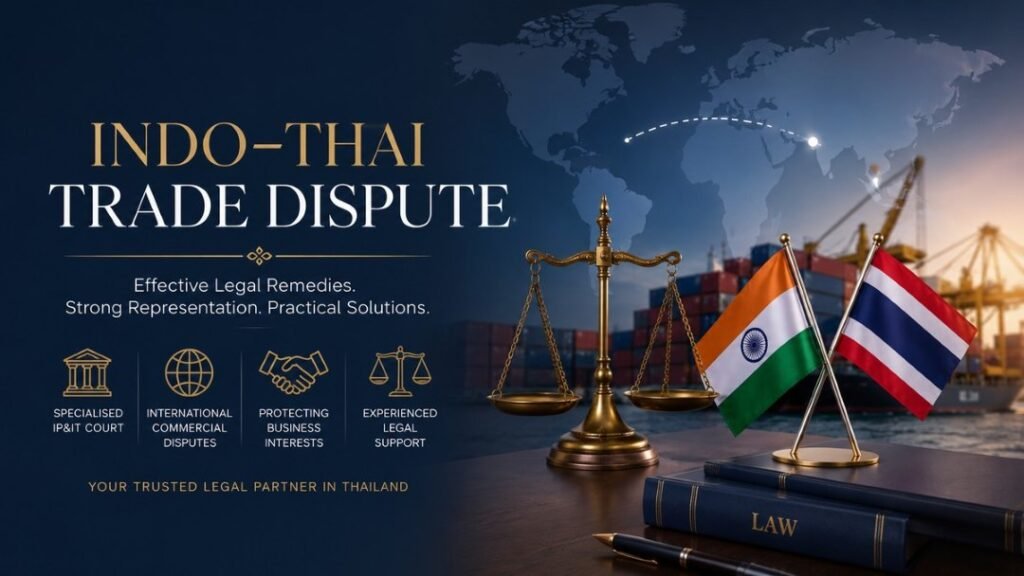
Commercial Disputes in Thailand: How Indian Businesses Can Recover Their Money Through Thailand?
Thailand is one of India’s largest trading partners in Southeast Asia. Every year, Indian businesses export machinery, chemicals, food products, textiles, steel, engineering goods and other products to Thai buyers, while Indian importers source electronics, automotive parts, industrial equipment, chemicals and consumer goods from Thailand.
One of the biggest concerns for Indian businesses is what happens when a Thai company fails to make payment, delivers defective goods, breaches terms of Purchase Order or refuses to honour its contractual obligations. Many businesses mistakenly believe that pursuing legal action in a foreign country is difficult, expensive and impractical and give up on the claim. However, Thailand has a specialised commercial court designed specifically to deal with international trade disputes
The Intellectual Property and International Trade Court (IP & IT Court) of Thailand is a specialised court established solely to adjudicate upon matters relating to international commercial transactions and intellectual property effectively and expeditiously. The procedures adopted by this Court to resolve such disputes aim at streamlining the process and ensuring that the forum is accessible to foreign individuals and business entities.
Section 7 of the Act defines the jurisdiction of the Intellectual Property and International Trade Court (IP & IT Court) and empowers it to adjudicate upon a wide range of cases including civil cases regarding international sale, exchange of goods or financial instruments, international services, carriage, letters of credit issued in respect of such transactions, insurance, civil and criminal cases regarding trademarks, copyrights, patents and cases arising from agreements on technology transfers or licensing agreements, etc.
For example, if an Indian exporter supplies goods to a Thai buyer and the buyer refuses to release payment after receiving the shipment, or if a Thai supplier delivers machinery that does not conform to contractual specifications, such disputes may fall within the jurisdiction of the IP&IT Court.
The IP & IT Court has exclusive jurisdiction to act as the court of first instance in respect of the subject-matters enumerated in Section 7 of the IP & IT Act barring general civil courts from entertaining such cases avoiding jurisdictional overlap and promoting procedural efficiency. The IP & IT Court is also empowered to call experts to provide technical insights, ensuring better-informed judicial decisions.
The IP & IT Court has adopted electronic filing (e-filing) system accessible to both individual litigants as well as juristic persons such as companies and legal entities enhancing accessibility, reducing administrative burden, and supporting efficient case management.
The filing fee for a dispute is approximately 2% of the claim value for claims up to THB 50 million, and for claims exceeding THB 50 million, an additional 0.1% is levied on the excess amount capping the maximum court fee which can be levied at THB 200,000 ensuring that the Court is accessible particularly in high-value commercial disputes.
The Court mandates a Pre-Trial Conference before proceeding to a formal hearing during which the Court identifies and narrows down disputed issues between the parties wherein Judges also actively encourage amicable settlement and mediation aiming to reduce litigation time and costs.
Further, the IP & IT Court requires the parties not residing or doing business within the jurisdiction of the court, to appoint an authorised representative to receive pleadings and official documents aiming to ease the procedural challenges of cross-border litigation.
Therefore, the Intellectual Property and International Trade Court of Thailand acts as a specialized judicial institution designed to address the growing complexity of international commercial and IP disputes expeditiously. With exclusive jurisdiction, structured procedures, emphasis on mediation, and digital integration, the framework reflects a progressive and business-friendly legal environment conducive to global trade.
International commercial disputes involve much more than domestic contract law. Questions relating to jurisdiction, applicable law, enforcement of judgments, evidence located in different countries and coordination with foreign lawyers often require careful legal planning.
For Indian businesses trading with Thailand, obtaining legal advice at an early stage can significantly improve the prospects of recovering outstanding payments, resolving contractual disputes and protecting commercial interests.
Whether you are an Indian exporter facing non-payment by a Thai buyer or an Indian importer or Thai exporter, understanding the role of Thailand’s Intellectual Property and International Trade Court is an important first step towards knowing your legal rights.